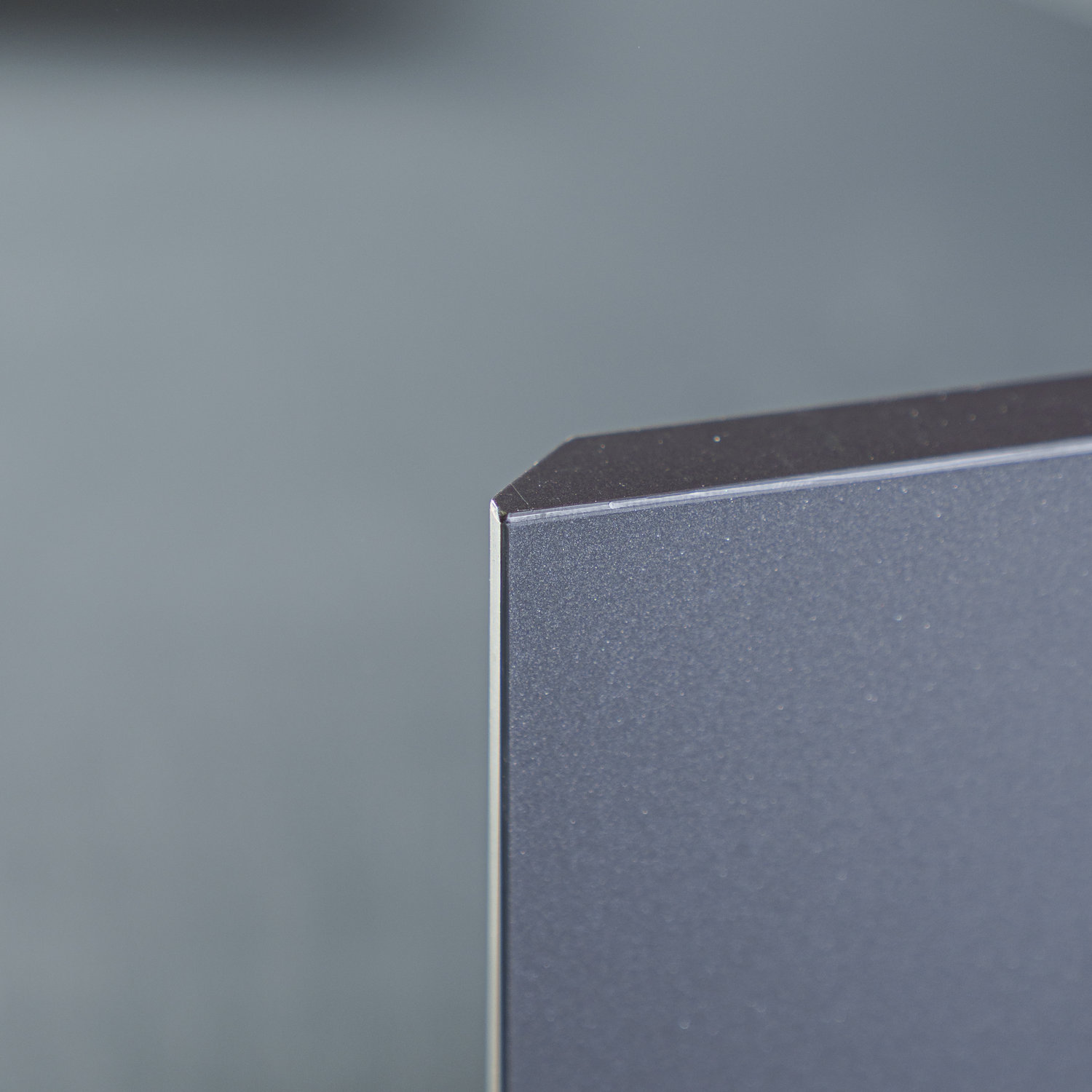
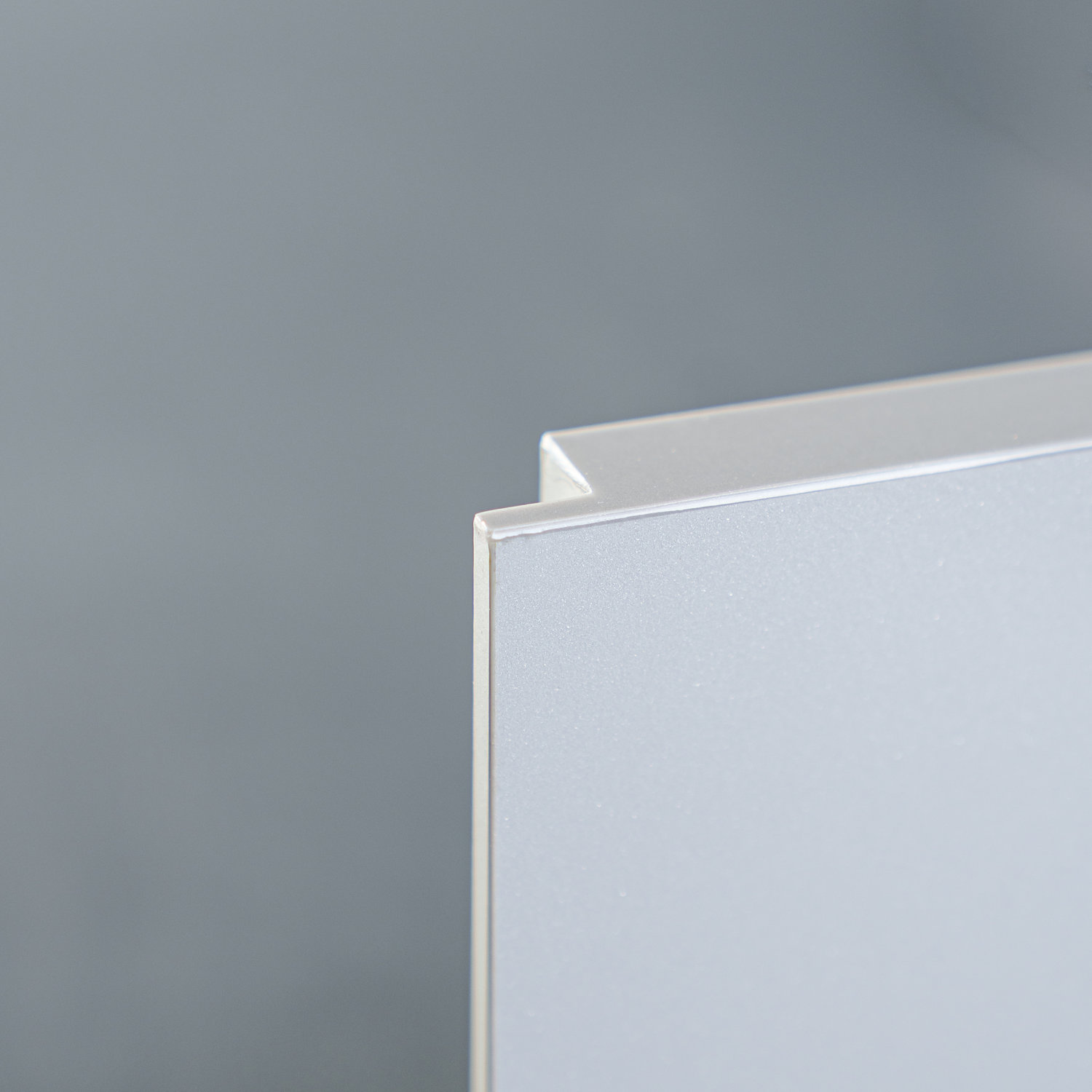
Premium Acrylic
Plasnor is a European manufacturer with extensive experience in producing high-quality plastic laminates designed for kitchen furniture surfaces. We offer a versatile product range, including:
To provide our customers with a finished, homogeneous and high value-added product, we also supply auxiliary products such as back layers and edgebanding in the same colour and material as our front laminates.
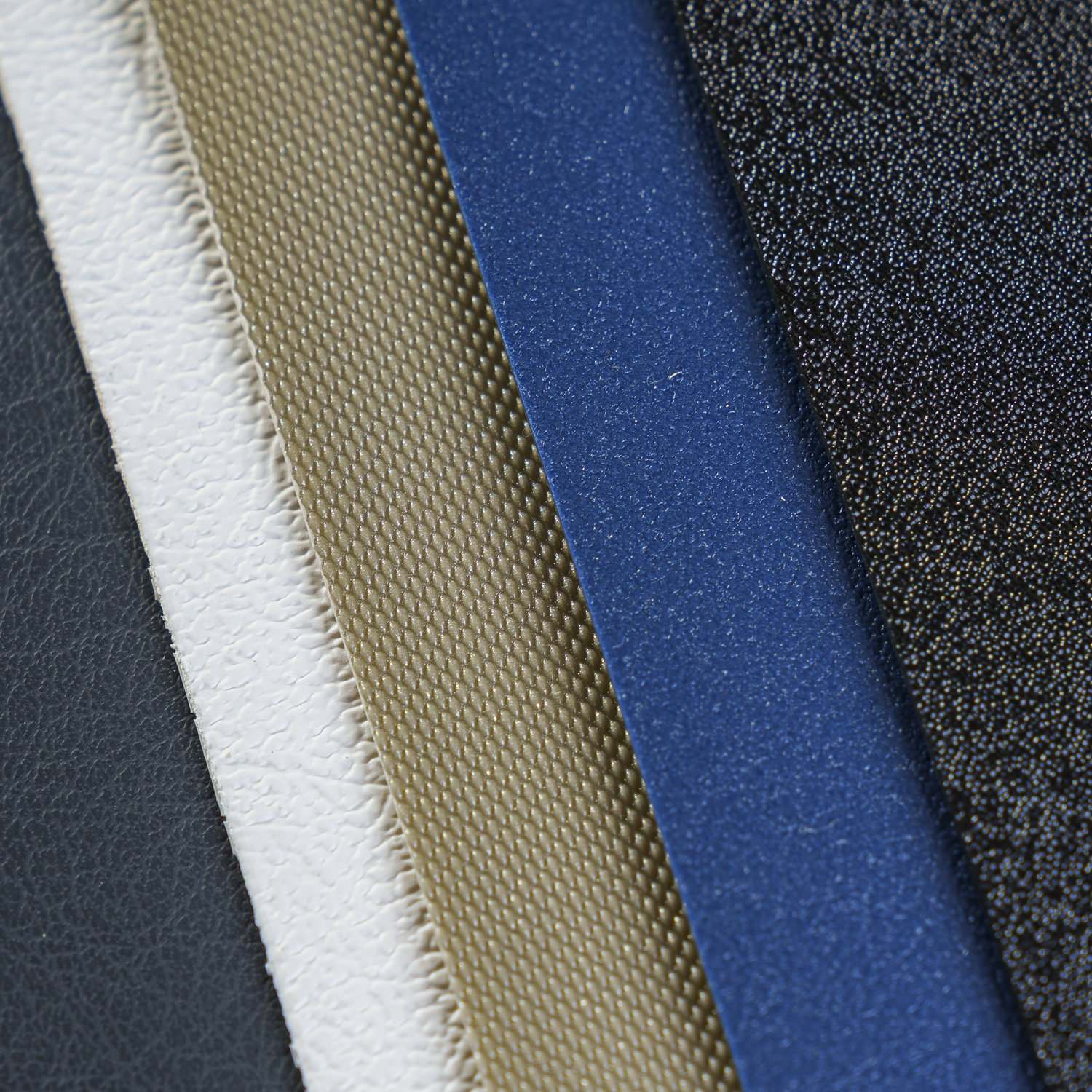
Our Premium Acrylic sheets are an ABS/PMMA plastic coextrusion used for vertical surfacing in all kinds of applications within the furniture sector. They make it possible to achieve the highest gloss level available on the market, far superior to alternative technologies (HPL, PET, PVC, etc.), as well as their characteristic “mirror effect”, enabling perfectly defined reflections.
Our sheets are available in the following dimensions:
The excellent colour stability of Premium Acrylic sheets under UV exposure and their resistance to chemical agents guarantee optimal product quality throughout their service life.
These non-toxic and recyclable materials are free from lacquers and/or harmful plastics (PVC), thus promoting sustainability and respect for the environment.
Solid and metallic
At PLASNOR, we offer a very wide range of solid colours inspired by current trends in the kitchen furniture industry. In addition, thanks to their ABS/PMMA composition, Premium Acrylic sheets are postformable and allow for an optimal edge finish, making it possible to manufacture integrated handles in the same material.
Decorative
Plasnor is a market leader in high-gloss acrylic imitation finishes (ABS/PMMA). Our Premium Acrylic designs provide a superior finish compared with other alternative technologies such as PVC/PMMA, PVC, PET, UV, etc.
We offer a range of decorative finishes imitating other materials such as aluminium, wood and marble.
Matte
We complete our Premium Acrylic finishes catalogue with matte versions of our main High Gloss colours. Thanks to their optimal finish, our matte surfaces are an excellent option compared with other technologies.
In addition, due to their thickness and composition, our sheets are easy to handle for those who intend to use them in parallel applications such as DIY. Like our High Gloss sheets, our matte sheets are also postformable and allow for an optimal edge finish, enabling the manufacture of integrated handles in the same material.
The excellent colour stability of Premium Acrylic sheets under UV exposure and their resistance to chemical agents guarantee optimal product quality throughout the product’s service life.
DESCRIPTION
HIPS-based solution (High-Impact Polystyrene) with an anti-slip additive in the surface layer, specially developed to line the bottom of kitchen drawers. Its properties prevent cutlery, crockery and kitchenware from moving inside the drawer.
OPTIONS
We offer 4 colour-matched options based on the colours of the main fittings and hinges available on the market, providing a monochrome interior environment.
In addition to the outstanding mirror effect of our Premium Acrylic sheets, PLASNOR offers the 2 mm CrystalAcrylic product in its catalogue, made of a multi-layer PMMA coextrusion and coloured through 20% of its thickness (0.4 mm).
As the transparent layer is 1.6 mm thick, these sheets achieve greater depth, providing a glass-like appearance with the following advantages:
For each colour in the Premium and Crystal Acrylic sheet catalogues, we provide our customers with the same colour in HIPS (High-Impact Polystyrene), in thicknesses of 0.80 and 2 mm respectively, for use as back layers or balancing sheets.
An economical, effective and elegant alternative to prevent board warping, especially in high-humidity environments.
With the same composition as our Premium Acrylic sheets (ABS/PMMA), Plasnor offers customers the possibility of manufacturing edge-banded doors with the same material on all faces, guaranteeing a distinctive perceived-quality finish.
The main advantage of this solution is that it enables the development of a homogeneous, exclusive and distinctive product in which ageing behaviour under UV exposure is uniform on all faces of the door, unlike doors manufactured with other technologies such as lacquered ABS or PVC edgebanding.
In addition, if a subsequent polishing process is carried out on the joints of the six faces, the thermoplastic nature of our sheets and edgebanding makes it possible to achieve a completely “seamless” finish, with no visible joints, providing a polished, high-end appearance.
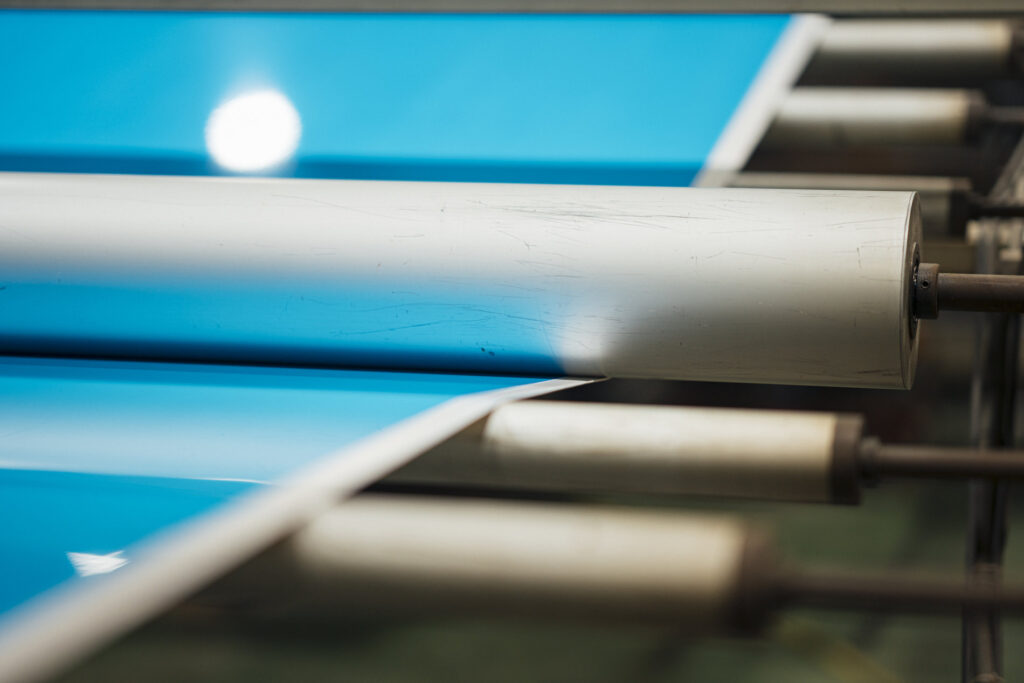
PUR hot-melt adhesive laminating lines are essential.
Below is a basic diagram of a production line.
The optimum pressure depends on the substrate used (MDF / chipboard / plywood), as well as on the amount of adhesive applied. Generally, higher pressure may cause more surface defects, as the acrylic foil reproduces any imperfections on the board surface. However, higher pressure also improves the bonding of the foil to the MDF.
In short, the right balance must be found. Our customers usually work with a pressing gap of between 0.1 mm and 0.3 mm.
The adhesive must be PUR. Other adhesive technologies are not recommended, as our experience shows they do not deliver reliable results. We recommend the following references: Kleiberit ref. 709.3, Henkel ref. QR4663 or Jowat 609.20. Any other PUR hot-melt adhesive should also work well. The adhesive must reach up to 140°C to be fluid enough. The roller through which the adhesive is applied should be at around 125°C.
Acrylic PMMA is a thermoplastic material, and waves may appear in the foil during the extrusion process. These waves do not affect the quality of the laminated board in any way, because they disappear when the foil is bonded to the board.
There are companies on the market that specialise in manufacturing ABS edgebanding. We recommend suppliers such as Dollken or Rehau, since their catalogues include our full colour range.
Our product can be postformed, and with the right machinery a minimum radius of 1.5 mm can be achieved.
ABS/PMMA is a thermoplastic material, which means its shape can be modified when the right amount of heat is applied. The most important aspect is to apply the heat exactly at the angle. The applied heat should be above 110°C.
We recommend waiting at least 24 hours before cutting the board, until the adhesive has dried and stabilised.
We recommend cleaning the surface with a microfibre cloth and water with liquid soap. Cleaners with antistatic properties are suitable for preventing static electricity.
We recommend Vuplex, a product specifically intended for cleaning plastics.
When removing the protective film, it is important to clean any adhesive residue from the sheet surface. Otherwise, it may appear that the surface has been scratched during handling, when it is actually adhesive residue.
Our recommendation for cleaning adhesive residue is to use damp microfibre cloths and clean the surface carefully. This simple procedure improves the scratch resistance of our foil and increases surface gloss.
In this case, we also recommend using Vuplex cleaner.
There are no specific storage requirements for our product. We only recommend bonding the sheets to the board within 6 months and not placing more than 3 tonnes on the pallet.
For over 50 years, Plasnor has transformed extrusion and thermoforming expertise into opportunities. With every part we produce, we help shape trust, progress and the future.