
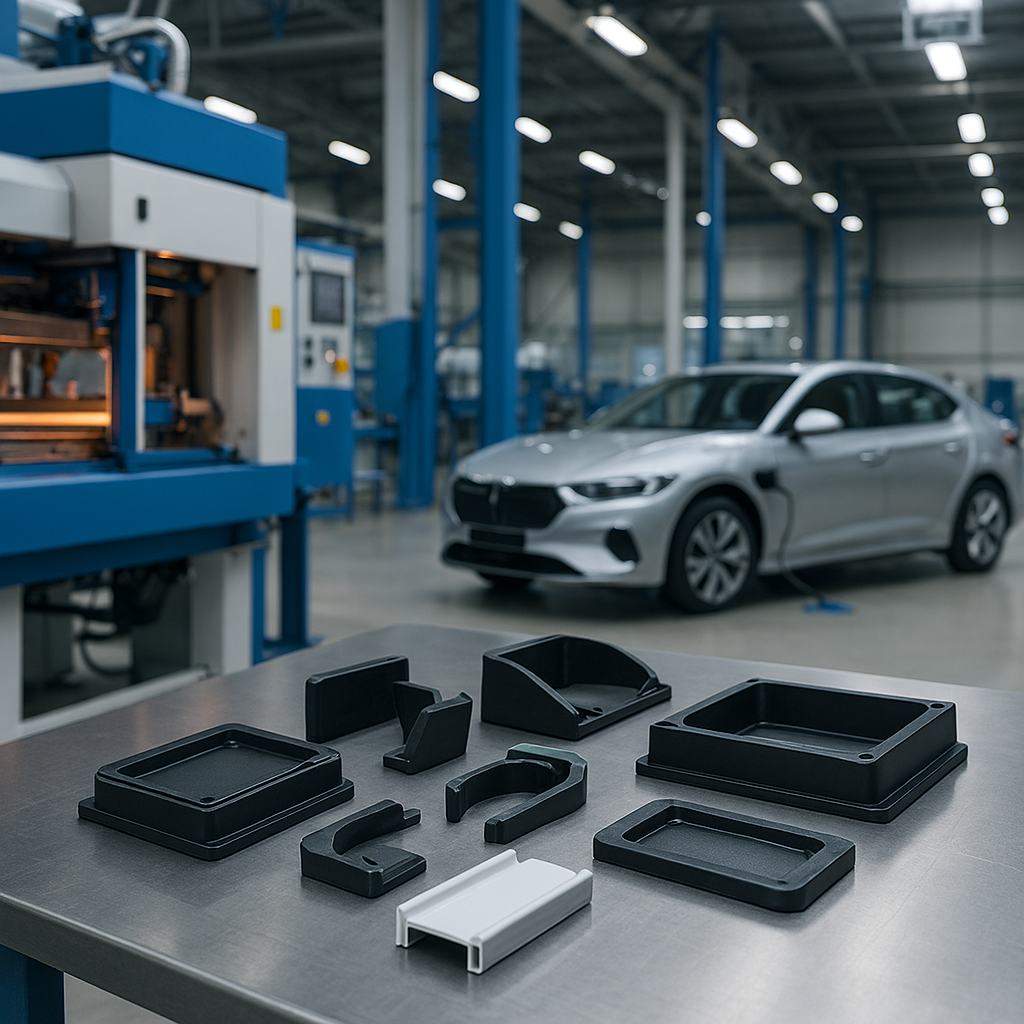
Electric mobility is transforming the design and manufacturing of components. Weight reduction, thermal management, electrical safety and reliability in serial production have become key priorities. In this context, technical plastic materials for electric vehicles play a fundamental role in addressing these new industrial challenges.
New requirements of electric vehicles
Unlike combustion vehicles, electric vehicles present specific technical requirements that directly impact material selection:
- Need to reduce weight to increase vehicle range.
- Efficient thermal management in batteries and electronic systems.
- Electrical insulation against high voltages.
- Dimensional precision in critical components.
- Repeatability and reliability in large-scale production.
These requirements demand the use of advanced materials from the earliest stages of the project.
Technical plastics: a strategic solution for automotive
Technical plastics for automotive applications offer an optimal balance between mechanical performance, functionality and design freedom:
- High mechanical and thermal resistance.
- Good performance under vibration and continuous stress.
- Suitable dielectric properties for electrical applications.
- Possibility to integrate functions into a single component.
- Cost optimization compared to metal solutions.
Thanks to these characteristics, plastic components for electric vehicles are gaining relevance in multiple applications.
Extrusion and thermoforming in components for electric vehicles
Industrial processes such as plastic extrusion for automotive and thermoforming allow the manufacture of custom components with high quality standards:
- Technical housings and protective parts for batteries.
- Functional and structural plastic components.
- Interior components with aesthetic and technical requirements.
- Electrical insulation and protection solutions.
- Technical plastic materials we can process: PEEK, POM, PA6, PTFE, among others.
The correct combination of material, design and process is key to ensuring tolerances, finishes and industrial scalability.
From development to serial supply
One of the biggest challenges in electric mobility projects is ensuring that the material behavior observed in prototypes remains consistent during production. Problems such as deformation, dimensional variations or quality failures can generate delays and additional costs.
Working with a partner specialized in technical plastic materials allows:
- Technical support from the design phase.
- Material and process validation.
- Stable production in medium and large series.
- Compliance with standards and regulations in the automotive sector.
Sustainability and innovation in plastic materials
Electric mobility is driving the use of more sustainable, recyclable materials and efficient processes. Innovation in technical plastics focuses both on improving performance and reducing environmental impact, aligning with regulatory requirements and manufacturers’ sustainability goals.
Technical plastic materials as a competitive advantage
The new challenges of electric mobility require reliable, scalable and technically solid solutions. Choosing technical plastic materials, combined with processes such as extrusion and thermoforming, allows manufacturers to develop optimized, safe components prepared for the future of electric mobility.